Industrial Mineral Procurement: The Ultimate Checklist for Calcium Carbonate Buyers In today’s competitive manufacturing environment, Industrial Mineral Procurement is no longer a simple purchasing function—it is a strategic decision that directly impacts product quality, operational efficiency, and long-term profitability.
Ground Calcium Carbonate (GCC) sits at the core of multiple industries, including plastics, paints, paper, rubber, and construction. Because of its high consumption volume and direct influence on product performance, even minor inconsistencies in GCC can result in significant operational consequences.
A single procurement mistake can lead to:
- Production downtime
- Equipment wear and failure
- Increased rejection rates
- Loss of customer confidence
The challenge is that many suppliers appear similar on the surface. However, true differences lie in geological quality, processing precision, and supply chain reliability.
This comprehensive checklist is designed to help procurement managers, quality engineers, and decision-makers eliminate uncertainty and confidently source high-performance GCC.

Industrial Mineral Procurement: The Ultimate Checklist for Calcium Carbonate Buyers
1. Geological Source Verification: The “Purity First” Principle
The foundation of all successful Industrial Mineral Procurement begins at the source—the quarry.
Not all limestone deposits are created equal. Geological variations directly influence chemical composition, impurity levels, and final product behavior.
Key Parameters to Verify
✔ Calcium Carbonate (CaCO₃) Content
- Target: ≥ 98% purity
- High purity ensures:
- Chemical stability
- Minimal side reactions
- Consistent formulation performance
✔ Impurity Profile (MgO, Fe₂O₃)
- Low magnesium (MgO) prevents unwanted reactivity
- Low iron (Fe₂O₃) preserves brightness and color
Even small increases in impurities can:
- Affect product color
- Reduce durability
- Create inconsistencies in sensitive applications
✔ Natural Brightness and Whiteness
- Target: ≥ 96–97% brightness
High natural whiteness:
- Reduces reliance on expensive pigments (e.g., titanium dioxide)
- Enhances final product aesthetics
- Improves formulation efficiency
Why This Matters
Geological quality cannot be corrected during processing. If the raw stone is inconsistent, the final product will inherit those flaws.
2. Technical Specifications: Precision Defines Performance
Once raw material purity is verified, the next step is evaluating how precisely the material is processed.
In Industrial Mineral Procurement, vague descriptions like “fine powder” are meaningless. What matters is measurable, repeatable data.
✔ Particle Size Distribution (PSD)
The most critical parameter in GCC performance.
- D50 (Median Size): Determines overall performance
- D97 (Top Cut): Controls presence of coarse particles
A high D97 value leads to:
- Surface defects
- Poor dispersion
- “Grittiness” in final products
✔ Batch-to-Batch Consistency
Ask your supplier:
- How do you ensure identical PSD curves across shipments?
- What process controls are in place?
Consistency ensures:
- Stable production settings
- Reduced trial-and-error
- Predictable outcomes
✔ Moisture Content
- Target: ≤ 0.2% (especially for plastics and adhesives)
Excess moisture can:
- Cause processing defects
- Reduce bonding performance
- Affect extrusion efficiency
The Procurement Insight
Precision in grinding is not just a quality factor—it is a cost-control mechanism.
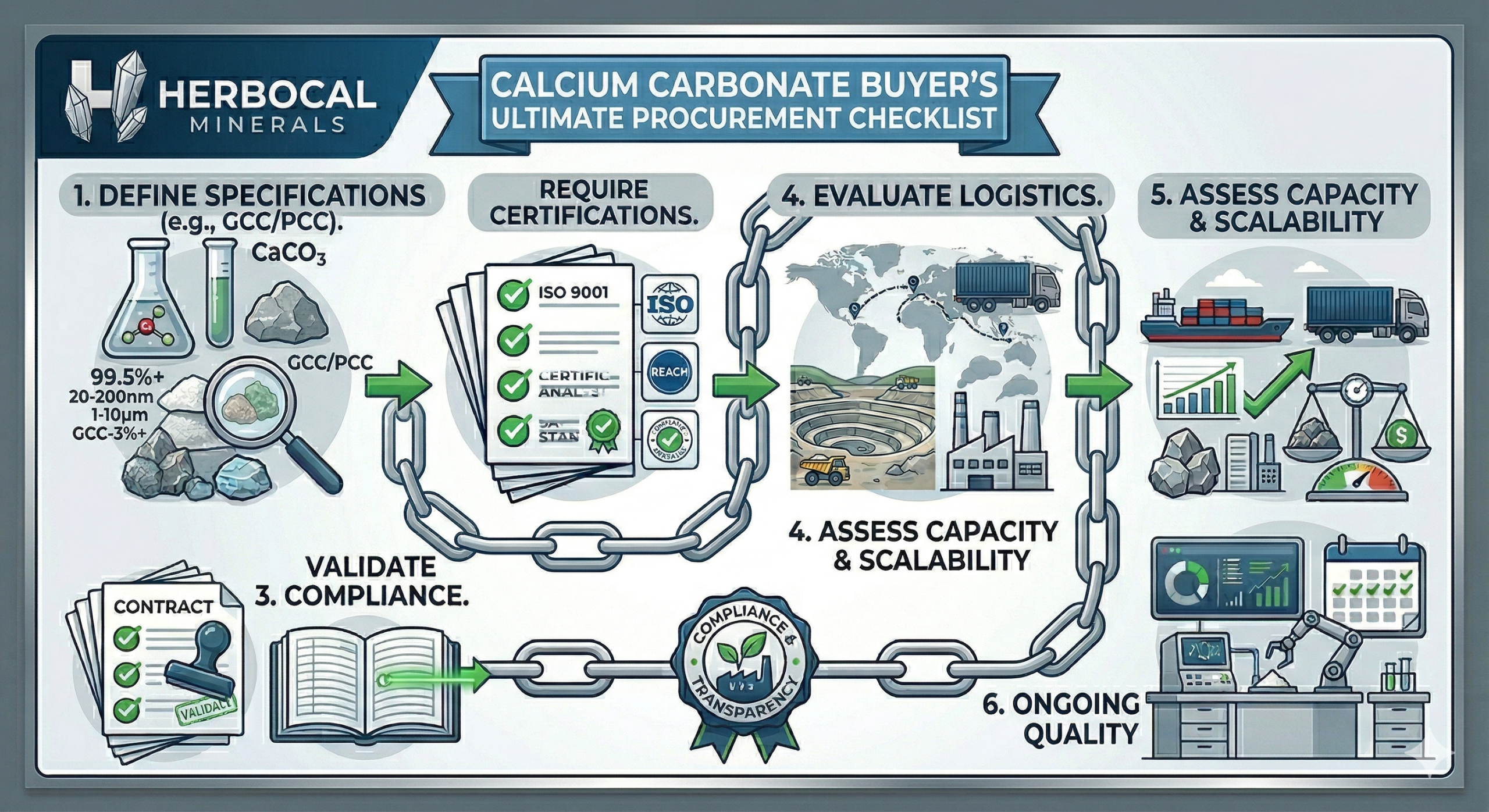
Industrial Mineral Procurement: The Ultimate Checklist for Calcium Carbonate Buyers
3. Equipment Protection: The Critical Role of Silica
One of the most overlooked risks in Industrial Mineral Procurement is material abrasiveness.
✔ Silica (SiO₂) Content
Silica acts as a natural abrasive.
High silica levels can:
- Accelerate wear on screws and barrels
- Damage molds and dies
- Increase maintenance frequency
Operational Impact
Using high-silica GCC results in:
- Higher maintenance costs
- Increased downtime
- Shorter equipment lifespan
What to Demand
- Low silica content
- Verified lab reports
- Transparent material composition
Strategic Advantage
Low-abrasion materials:
- Extend equipment life
- Improve operational stability
- Reduce long-term capital expenditure
4. Supply Chain Reliability: Beyond the Product
Even the highest-quality GCC is useless if it cannot be delivered on time.
Industrial Mineral Procurement must include a full evaluation of logistics and supply chain performance.
✔ Production Capacity
Verify:
- Monthly output capability
- Scalability for future demand
A reliable supplier should:
- Support your growth
- Avoid becoming a bottleneck
✔ Strategic Location and Shipping Efficiency
Suppliers located near major logistics hubs offer:
- Faster delivery times
- Lower shipping costs
- Reduced risk of delays
For example, suppliers operating near the Suez Canal benefit from direct access to global trade routes connecting Europe, Asia, and Africa.
✔ Packaging Integrity
Check:
- Moisture-resistant packaging
- Durability for sea freight
- Protection against contamination
Proper packaging ensures:
- Product arrives in optimal condition
- No quality degradation during transit
5. Compliance and Certification: Your “Quality Passport”
No Industrial Mineral Procurement process is complete without verifying compliance documentation.
✔ ISO Standards
Ensure the supplier follows:
- ISO 9001 (Quality Management)
- ISO 14001 (Environmental Management)
Certified systems indicate:
- Controlled processes
- Reliable output
- Commitment to global standards
✔ REACH and FDA Compliance
For international markets:
- REACH Regulation ensures compliance with European chemical safety laws
- Food and Drug Administration approval is essential for food-contact and pharmaceutical applications
✔ Certificate of Analysis (COA)
Every shipment must include:
- Batch-specific laboratory results
- Verified chemical and physical data
A COA provides:
- Transparency
- Traceability
- Quality assurance
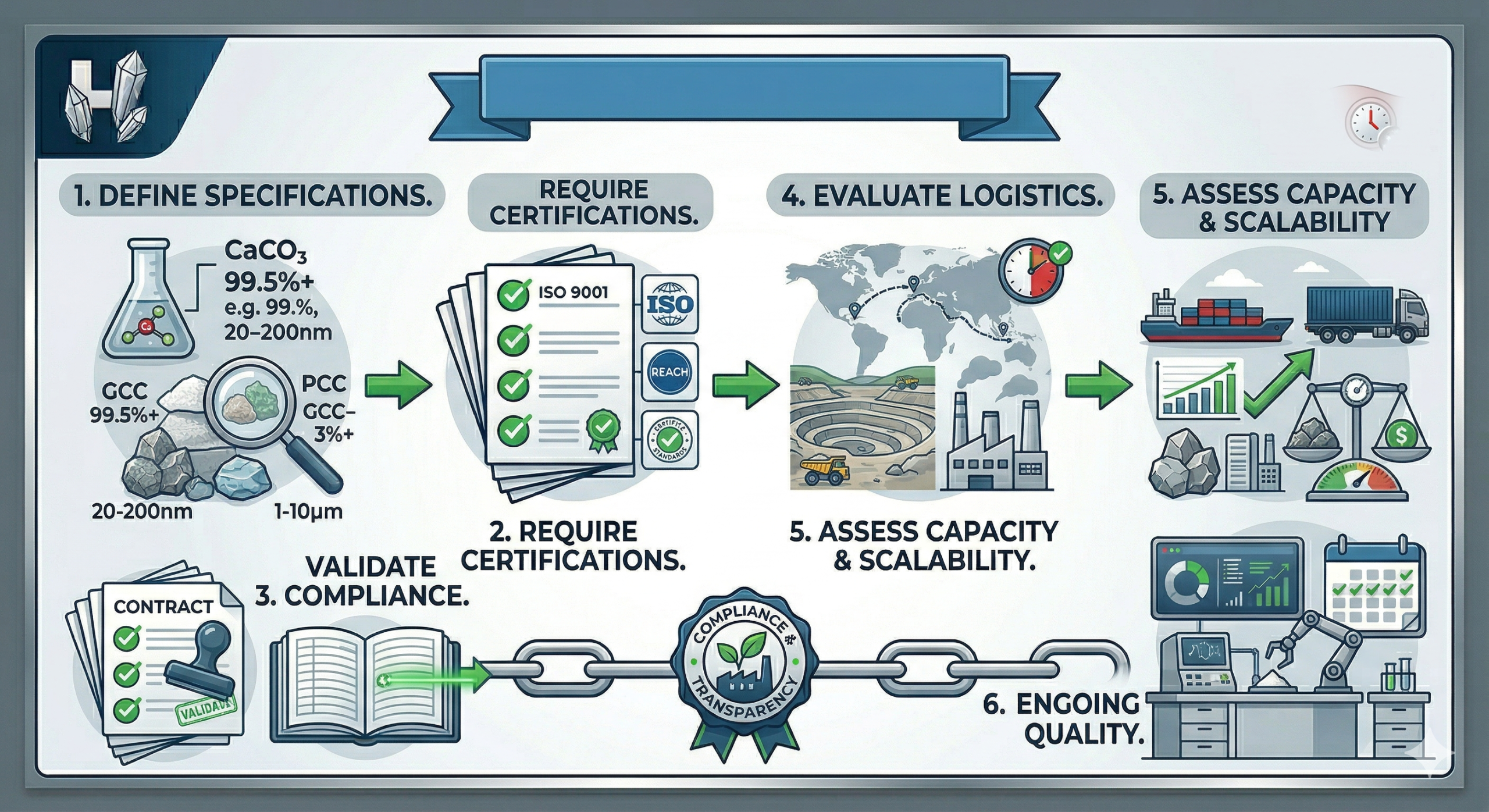
Industrial Mineral Procurement: The Ultimate Checklist for Calcium Carbonate Buyers
6. Hidden Cost Factor: Oil Absorption Efficiency
For coatings, paints, and adhesives, oil absorption is a critical economic factor.
✔ Oil Absorption Value
If GCC absorbs excessive binder:
- Production costs increase
- Formulation efficiency decreases
✔ Optimization Benefits
Low oil absorption enables:
- Reduced resin consumption
- Lower formulation cost
- Improved product performance
Procurement Insight
This parameter directly affects profitability—not just quality.
Quick Desk Reference: Procurement Checklist
| Category | What to Verify | Why It Matters |
|---|---|---|
| Purity | CaCO₃ ≥ 98% | Chemical stability |
| Color | Brightness ≥ 96% | Reduced pigment cost |
| Precision | Controlled PSD (D50/D97) | Smooth product finish |
| Safety | Low silica content | Equipment protection |
| Logistics | Port proximity & capacity | On-time delivery |
| Compliance | ISO, REACH, FDA, COA | Risk-free operations |
| Efficiency | Low oil absorption | Cost optimization |
Common Procurement Mistakes to Avoid
Even experienced buyers fall into these traps:
- Choosing based on price alone
- Ignoring batch consistency
- Overlooking silica content
- Skipping logistics verification
- Accepting incomplete documentation
Avoiding these mistakes can significantly improve operational performance.
Conclusion: Procurement Excellence Drives Manufacturing Success
Industrial Mineral Procurement is not about finding the cheapest supplier—it is about securing the most reliable one.
A high-quality GCC supplier ensures:
- Consistent production output
- Reduced operational risks
- Lower long-term costs
- Stronger market competitiveness
When every parameter—from geology to logistics—is verified, procurement becomes a source of strength rather than uncertainty.
If you are ready to upgrade your procurement strategy and eliminate risk from your supply chain, it is time to work with a partner who meets every requirement on this checklist.
Choose a supplier who delivers:
- Verified high-purity materials
- Consistent technical specifications
- Reliable global logistics
- Full compliance documentation
Take control of your Industrial Mineral Procurement today—and turn your raw material sourcing into a competitive advantage.