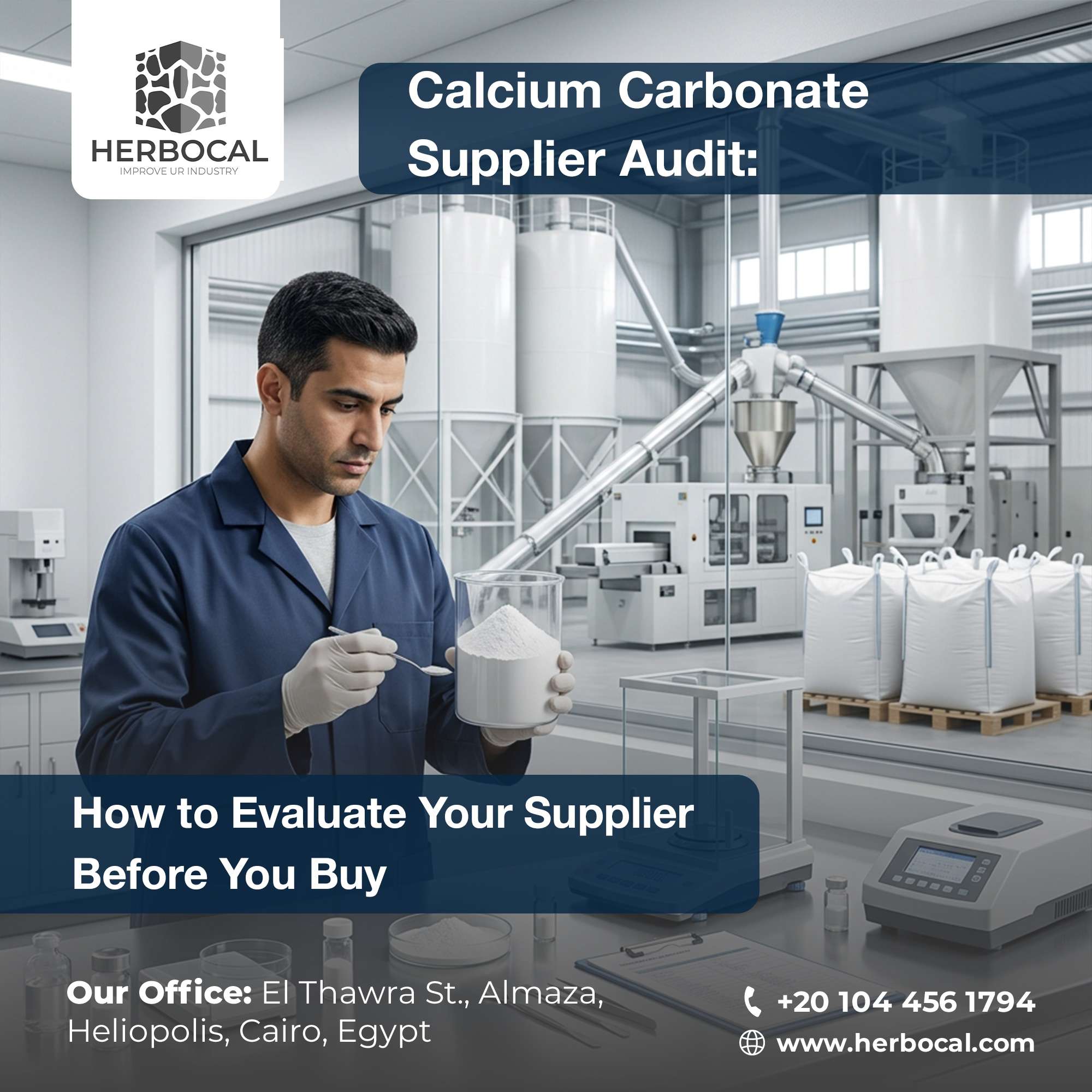
Supplier Transparency is one of the most important factors behind successful procurement, especially when companies purchase industrial raw materials from international suppliers.
When a manufacturer places an order for calcium carbonate, the transaction involves much more than a price per ton.
The buyer needs to understand exactly what is being purchased, which specifications apply, what is included in the quotation, when the order will be ready, how it will be shipped, and what documentation will accompany it.
When this information is clear from the beginning, procurement becomes easier to manage.
When it is unclear, even a competitive quotation can create unexpected costs and operational problems.
For manufacturers across GCC markets, where international sourcing is an important part of industrial procurement, transparency can make the difference between a smooth supplier relationship and a difficult one.
At HERBOCAL, we believe transparency should be part of every stage of the customer relationship—from the first technical discussion to production, shipment, and delivery.

Supplier Transparency: Why It Is Key to Procurement Success
What Does Supplier Transparency Really Mean?
Supplier transparency means providing customers with clear, accurate, and relevant information throughout the purchasing process.
It does not mean revealing every internal business detail.
Instead, it means making sure that the information a buyer needs to make an informed decision is available and understandable.
For an industrial calcium carbonate buyer, transparency can include:
- Clear product specifications
- Accurate quotations
- Defined commercial terms
- Transparent Incoterms
- Clear shipment information
- Realistic lead times
- Quality documentation
- Packaging details
- Order updates
- Clear communication when circumstances change
These details may appear simple.
But when they are consistently available, they create confidence.
Why Transparency Matters in GCC Procurement
International procurement naturally involves a degree of uncertainty.
The supplier and buyer may be located in different countries.
They may operate under different regulations.
The product may need to cross international borders.
The shipment may involve ports, freight forwarders, customs procedures, and multiple documents.
This makes communication especially important.
For a GCC manufacturer purchasing calcium carbonate from an international supplier, a lack of clarity can lead to questions such as:
What exactly is included in the price?
Which grade am I receiving?
When will the shipment be ready?
Which port will be used?
What documents will I receive?
Will the product specifications remain consistent?
A transparent supplier answers these questions before they become problems.
Transparent Product Specifications Build Confidence
One of the most important areas of supplier transparency is the product itself.
Calcium carbonate is not a single standardized material that performs identically in every application.
Different manufacturers may require different:
- Particle sizes
- Brightness levels
- Purity levels
- Moisture levels
- Coating characteristics
- Chemical specifications
A buyer should therefore know exactly what grade is being offered.
This is particularly important when the material will be used in demanding industrial applications.
At HERBOCAL, product specifications and quality requirements are an important part of the supply process. The company provides different calcium carbonate solutions for applications including plastics, PVC, paints, coatings, paper, rubber, construction, adhesives, ceramics, and other industries. (herbocal.com)
Clear technical information helps buyers determine whether a product is actually suitable for their production process.
Transparent Pricing Prevents Unpleasant Surprises
Price transparency is another critical part of procurement.
A quotation should make it clear what the buyer is actually paying for.
This is especially important in international trade, where the difference between FOB, CIF, and other commercial terms can significantly affect the final cost.
For example, a lower FOB quotation may not necessarily be cheaper than a higher CIF quotation once freight and other relevant costs are included.
This is why procurement teams should ask:
- What is included in the quoted price?
- Which Incoterm applies?
- What is the named port?
- Is freight included?
- Is insurance included where applicable?
- Which destination costs remain the buyer’s responsibility?
- How long is the quotation valid?
The clearer these details are, the easier it becomes to compare suppliers fairly.

Supplier Transparency: Why It Is Key to Procurement Success
Transparency in Quality Control Matters
A supplier’s quality-control process is another area where transparency creates value.
Manufacturers need confidence that the calcium carbonate they receive will meet the agreed specifications.
This requires more than simply receiving a certificate after the shipment.
Buyers should understand:
- Which characteristics are tested?
- How frequently are tests performed?
- What specifications are being measured?
- How are batches controlled?
- What documentation is available?
HERBOCAL applies quality-control procedures to its calcium carbonate products, with attention to characteristics such as particle size, brightness, purity, and moisture. (herbocal.com)
For buyers, this type of information provides greater visibility into how product consistency is maintained.
Clear Lead Times Help Manufacturers Plan Production
A supplier can offer excellent product quality and competitive pricing, but if delivery dates are unclear, the procurement process becomes difficult.
Manufacturers plan production around raw-material availability.
If calcium carbonate is expected to arrive on a certain date, the production team may schedule manufacturing accordingly.
If the shipment is delayed and the buyer is not informed early enough, the consequences can include:
- Production delays
- Inventory shortages
- Emergency purchases
- Additional transportation costs
- Missed customer deadlines
A transparent supplier should provide realistic lead times rather than simply promising the fastest possible delivery.
And when circumstances change, communication should happen as early as possible.
Transparency Is Especially Important During Delays
No international supplier can control every event.
Ships can be delayed.
Ports can become congested.
Weather can affect transportation.
Demand can change unexpectedly.
Production schedules can sometimes shift.
The real test of supplier transparency is therefore not what happens when everything goes perfectly.
It is how the supplier communicates when something does not go according to plan.
A transparent supplier should explain:
What happened?
What is the expected impact?
What is being done about it?
When should the customer expect the next update?
This gives the buyer an opportunity to adjust its own plans.
Silence creates uncertainty.
Clear communication creates options.
Documentation Is Part of Transparency
International industrial procurement involves documentation.
Depending on the transaction and destination, buyers may require different commercial, shipping, customs, and quality-related documents.
The exact documentation depends on the shipment and applicable regulations, but the principle remains the same:
The buyer should know what documents are being provided and when they will be available.
Missing or incorrect documents can delay customs clearance or create additional administrative work.
An experienced international supplier should understand the importance of accurate documentation and clear communication around it.
Transparency Reduces Procurement Risk
Every procurement decision carries some level of risk.
The buyer may be concerned about:
- Product quality
- Delivery reliability
- Price changes
- Shipping delays
- Documentation
- Supplier capacity
- Communication
Supplier transparency does not eliminate all these risks.
Instead, it makes them visible.
And visible risks are easier to manage than hidden ones.
This is one of the most important reasons transparency matters.
A buyer cannot plan around a problem it does not know exists.
Transparency Helps Buyers Compare Suppliers Properly
Imagine two suppliers offering calcium carbonate.
Supplier A provides a short quotation with only:
Calcium Carbonate — $XXX/MT
Supplier B provides:
- Product grade
- Technical specifications
- Packaging
- Quantity
- Incoterm
- Named port
- Payment terms
- Lead time
- Validity period
- Quality documentation
Which quotation gives the buyer more useful information?
Clearly, the second.
Even if Supplier A’s price appears lower, the buyer does not yet know whether both offers are actually comparable.
Transparency allows procurement teams to compare like with like.
That can lead to better purchasing decisions.
Supplier Transparency: Why It Is Key to Procurement Success
Supplier Transparency Creates Stronger Business Relationships
Supplier Transparency is more than a procurement principle. It is one of the foundations of trust between industrial buyers and suppliers.
When a calcium carbonate supplier consistently communicates accurate and clear information, buyers become more confident in future transactions. Over time, this clarity makes the entire purchasing process easier.
The buyer knows what to expect.
The supplier understands the buyer’s requirements.
Both sides can plan production, purchasing, and logistics more effectively.
This is particularly important for manufacturers with recurring calcium carbonate requirements, where even small misunderstandings can create operational or financial problems.
A transparent first transaction can therefore become the foundation for a long-term commercial relationship.
The Role of Supplier Transparency in Technical Communication
Industrial purchasing decisions often involve technical requirements that cannot be reduced to a simple product name.
For example, saying:
“We need calcium carbonate.”
is not enough.
A professional supplier may need to understand:
- Final application
- Required particle size
- Desired brightness
- Coating requirements
- Chemical purity
- Processing method
- Packaging requirements
- Monthly consumption
The more accurately these requirements are communicated, the easier it becomes to identify the appropriate calcium carbonate grade.
This is where Supplier Transparency becomes particularly valuable. Clear technical communication helps both parties understand exactly what is required before production and shipment begin.
HERBOCAL offers different calcium carbonate grades and customized solutions based on application requirements, allowing customers to select products according to their specific manufacturing needs.
This technical dialogue is an essential part of transparent industrial procurement.
Supplier Transparency Supports Better Cost Management
At first glance, Supplier Transparency may appear unrelated to cost control.
In reality, clear communication can have a direct impact on the total cost of procurement.
Unexpected expenses often arise because important information was not clearly understood at the beginning of the transaction.
For example:
A buyer assumes freight is included.
It is not.
A buyer assumes a particular technical specification applies.
It does not.
A buyer expects delivery by a certain date.
The supplier never formally confirmed it.
Each misunderstanding can create additional costs, production pressure, or delays.
Clear information at the beginning helps reduce these risks.
For this reason, Supplier Transparency is not simply a communication practice.
It is also an important cost-management and risk-management strategy for international buyers.
How GCC Buyers Can Evaluate Supplier Transparency
Before selecting an international calcium carbonate supplier, procurement teams can look for several practical indicators of Supplier Transparency.
Does the Supplier Explain the Product Clearly?
A professional supplier should be able to provide relevant technical information about the offered calcium carbonate grade, including the specifications that matter to the customer’s application.
Is the Quotation Detailed?
The quotation should clearly explain important commercial conditions, product specifications, packaging, quantity, and other relevant costs or terms.
Are Incoterms Clearly Defined?
Buyers should understand whether the quotation is based on FOB, CIF, or another agreed Incoterm.
Clear commercial terms are an important part of Supplier Transparency because they help buyers understand what is included in the quoted price.
Are Lead Times Realistic?
Reliable suppliers should provide realistic production and delivery estimates rather than promising unrealistic dates simply to secure an order.
Is Quality Documentation Available?
The supplier should be able to explain its quality-control procedures and provide relevant technical documentation when required.
Does the Supplier Communicate Proactively?
Good suppliers do not wait until the last moment to inform customers about important changes involving production, shipment, or delivery.
Are Questions Answered Directly?
If a supplier avoids providing clear answers before the first order, this can be an important warning sign for future transactions.
A strong level of Supplier Transparency should be visible before the commercial relationship becomes a long-term commitment.
HERBOCAL’s Approach to Transparent Supply
For HERBOCAL, Supplier Transparency begins with understanding what the customer actually needs.
The company is based in Minya, Egypt, close to the limestone resources used in its calcium carbonate production, and has access to Alexandria Port for international export operations.
HERBOCAL serves international customers across the Middle East and other global markets, supplying calcium carbonate solutions for different industrial applications.
For international buyers, this makes clear communication particularly important.
Customers need to understand their product specifications.
They need visibility into order planning.
They need clarity around shipping arrangements.
And they need confidence that the supplier will communicate when circumstances change.
The objective is simple:
No unnecessary surprises.
Supplier Transparency Should Continue After the Sale
Supplier Transparency should not stop when the purchase order is signed.
In fact, communication can become even more important after the order is confirmed.
A professional calcium carbonate supplier should maintain appropriate communication around:
- Production status
- Quality checks
- Packaging
- Shipment readiness
- Loading
- Export documentation
- Transit
- Delivery
This does not mean sending unnecessary updates every day.
It means providing the right information at the right time.
Effective Supplier Transparency should make the buyer’s job easier by giving the procurement team enough information to manage inventory, production schedules, and logistics confidently.
What Does a Transparent Supplier Look Like?
A transparent supplier does not necessarily promise that everything will always be perfect.
Instead, it provides realistic information.
It explains what it can do.
It clearly communicates what it cannot do.
It identifies potential risks.
It confirms technical and commercial requirements.
It documents important agreements.
And when something changes, it informs the customer before the issue becomes more serious.
This is the practical meaning of Supplier Transparency in international B2B procurement.
It is not about making unrealistic promises.
It is about creating a clear understanding between both sides.
The Bottom Line: Why Supplier Transparency Matters
Successful procurement is built on more than competitive prices.
It depends on having the right information at the right time.
For GCC manufacturers purchasing calcium carbonate, strong Supplier Transparency can help improve:
Decision-making
Cost control
Quality management
Production planning
Logistics coordination
Risk management
Supplier relationships
At HERBOCAL, transparency should be part of the entire supply process—from discussing technical requirements and product specifications to agreeing on commercial terms and coordinating international shipments.
Because when buyers know exactly what they are purchasing, what they are paying for, and what they can expect, procurement becomes easier to manage.
The best supplier is not simply the one that gives you a quotation.
It is the one that gives you clarity.
If your company is sourcing calcium carbonate for the GCC market and values clear communication, consistent quality, and reliable international supply, HERBOCAL can discuss your product specifications, order requirements, and supply needs.
Frequently Asked Questions
What is Supplier Transparency?
Supplier Transparency means providing buyers with clear, accurate, and timely information about product specifications, pricing, commercial terms, quality, lead times, shipping, documentation, and other relevant aspects of the purchasing process.
Why Is Supplier Transparency Important in Procurement?
Supplier Transparency helps buyers make better comparisons, identify potential risks, control unexpected costs, plan production, and build stronger commercial relationships with suppliers.
How Does Supplier Transparency Affect Calcium Carbonate Procurement?
It allows buyers to clearly understand the calcium carbonate grade, technical specifications, pricing terms, quality standards, packaging, delivery schedule, and shipping arrangements before placing an order.
Can Supplier Transparency Help Reduce Procurement Costs?
Yes. Clear communication can help reduce unexpected costs by making important commercial, technical, and logistics information clear before the transaction is finalized.
It also allows buyers to compare suppliers more accurately based on the total cost and value of supply, rather than the quoted price alone.
What Should GCC Buyers Ask a Calcium Carbonate Supplier?
Buyers should ask about product specifications, quality control, packaging, order quantity, quotation currency, Incoterms, lead time, shipping arrangements, documentation, and quotation validity.
The supplier’s willingness to provide clear answers to these questions is an important indicator of Supplier Transparency.
Does HERBOCAL Provide Different Calcium Carbonate Grades?
Yes. HERBOCAL supplies different calcium carbonate solutions, including Ground Calcium Carbonate, coated calcium carbonate, micronized products, and high-brightness grades for different industrial applications.
Where Is HERBOCAL Located?
HERBOCAL is based in Minya, Egypt, near important limestone resources, with access to Alexandria Port for international export operations.